For an enterprise product, time to value makes a great north star for deployment. Here are a few thoughts on making it useful.
The most important thing to realize is that every deployment starts underwater. The client has just signed, so expectations are high. They’ve started paying, and they still have to change how they work before they see any value.
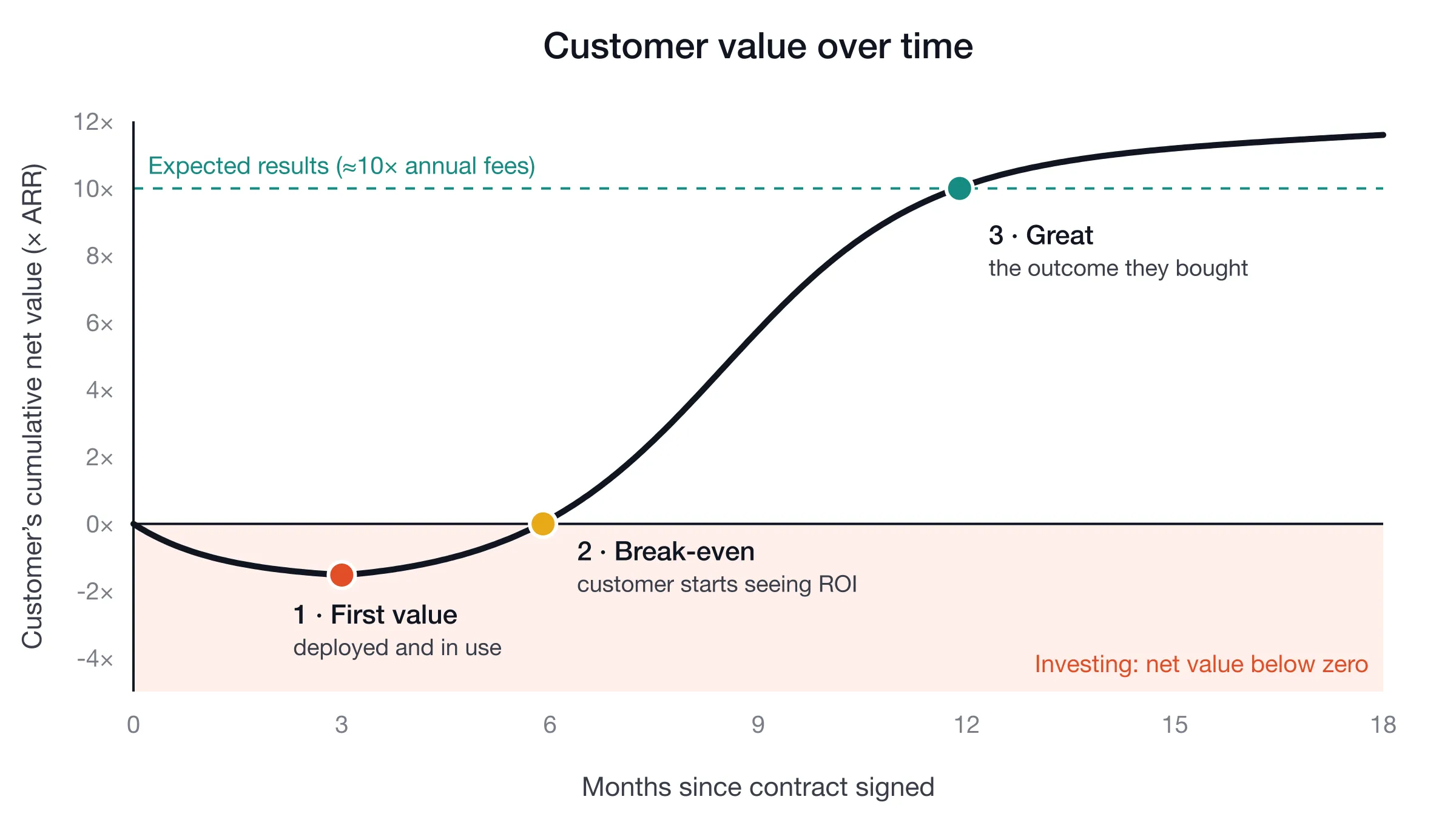
So if you measure cumulative value over time, you start in the negative. Your goal is to reach full ROI (usually about 10× what they’ve spent) by renewal. The chart below shows that curve and three key milestones:
First value. They’re deployed and using the product. Cumulative value stops falling and starts to climb.
Break-even. Value matches everything they’ve invested. This is exciting for a CS team but only “meh” for the customer. It’s where ROI starts to accrue.
Great. Accumulated value reaches roughly 10× ARR, a common rule of thumb for what justifies switching to a new platform.
Many definitions of time to value stop at first value, measured from contract signature. That’s useful, but only a start. Define what each milestone looks like for your customers, and aim to get every one of them to great.
How often have you completed a self-help book with a resolve to do everything differently forever? This feeling can undermine personal growth.
I finished Oliver Burkeman’s Meditations for Mortals with exactly that sense – a rah-rah empowerment to let go of my anxiety, live in the present, embrace my limitations, and be productive (but not too much).
He offered several insights for us perfectionists trying to navigate the world – e.g. to accept that everything is and will be imperfect, to do concerted work for three hours and allow enjoyment the rest of the day, to create dailyish practices because they’re more resilient than daily ones.
Despite such well-tempered tips, my over-eager mind still managed to bludgeon itself: You’ve already spent two hours on this post – hurry up and get ’er done! I’m sure it won’t be perfect, but certainly it can be better than this!
Fortunately, Burkeman offers an antidote to these poisonous thoughts:
Do one thing that matters today
This singular phrase brings meaning, focus, limitation, and presence. Practicing it – dailyish – adds up to a life that’s impactful and fulfilling.
Rather than doing everything differently forever, I can do one important thing, today. For me, today, it’s publishing this post. Imperfectly.
I’m reacting to David Graeber’s book Debt and how it relates to our modern interpretation of capitalism and embrace of AI…
Recap of Graeber’s Debt, Chapter 1
Graeber, a professor of anthropology at the London School of Economics and organizer of Occupy Wall Street, opens by pointing out how intertwined our concept of the particular financial instrument of debt has become with morality itself. Our acceptance that “surely one must pay their debts” has become so absolute that we unflinchingly allow it as a bludgeon that rich can use against poor. We routinely forgive usurers for making unconscionable or unrepayable loans by using violence to enforce their “right to be repaid” without consideration to how risky or immoral their loan was in the first place.
debt
noun. 1) a sum of money owed. 2) the state of owing money. 3) a feeling of gratitude for a favour or service.
– *Oxford English Dictionary
Compelling examples
Two of his illustrations particularly resonated with me:
Haiti, a nation founded in 1804 by former plantation slaves, had the temerity to rise up against its French masters and then beat Napoleon’s army sent to return them to bondage. France, in return, claimed Haiti owed 150 million francs for the expropriated lands and the expenses of outfitting the army they fought. The rest of world supported France’s claim and imposed embargoes until Haiti paid the impossible sum (some $600 million in today’s money), leaving the poor nation forever since in peonage.
The IMF, supposed defenders of democracy (which they equate to capitalism), in the 1980s forced unpopular austerity programs on Third World countries in the name of repaying loans that unelected dictators had taken from Citibank and Chase. Nevermind that those dictators largely pocketed payments in their Swiss bank accounts, or that the countries had already repaid three or four times the amount borrowed. Through the “miracle of compound interest” – over 20% – those repayments still hadn’t made a significant dent in the principle. And thus the IMF, with the world’s support, forced the elimination of support programs to fight malaria and put food in the mouths of hungry children.
Implications on Morality
Are these moral actions?
I’m not one to argue that all debt is bad, nor that lenders should not have a reasonable expectation of repayment. State enforcement of contractual obligations is important. However, Graeber points out that lenders should have a certain degree of risk – otherwise what disincentive would they have for making a completely stupid loan? And historical precedents of jubilees and other forms of debt forgiveness have been tools for fighting the moral wrong of compounding wealth inequality.
I don’t yet have formed opinions on the implications of these realizations. But have two important takeaways: 1) debt has often been a coercive financial instrument enforced by violence, and 2) we should separate in our minds its financial meaning from our entangled moral one. Today we directly conflate debt repayment with morality, but don’t have as simple or straightforward judgment on making exploitative or irresponsible loans.
What’s this got to do with AI?
I believe there’s a similar moral conflation taking place with AI today, and even a ceding of important intellectual and moral ground in calling it “intelligence.”
For instance, how different would we feel about AI (particularly LLMs) if we called them “Predictive Text Engines Trained on Stolen Intellectual Property?” Maybe “SWIPEs” – Stolen World Intellectual Property Engines?
As a society, we’ve largely accepted, almost without protest, that a handful of individuals and companies have swooped up the intellectual work of millions or billions of people over generations, used it for free to train their SWIPEs, and now sell it back to us at profit. That’s not to say that they’ve not accomplished miraculous technological feats along the way. Nor that the services provided are not life-changing. They are.
But there is a heist at the foundation of the industry that reminds me of that described by Graeber. And a broad abdication of moral principles from society that has allowed us all to be implicated in it.
Footnotes and other thoughts:
We do have laws against usury and condemn “loan sharks.” We also have caps on loan rates (though Claude says Florida is 25%, and that the 12% listed on this page is actually a “default” for unspecified loans)
This is the start of a thinking log. Not finished essays — reactions to talks, articles, and books; coaching reflections; observations about AI, product, and leadership while they’re still half-formed.
A few things I want to hold myself to here:
Favor a point of view over a summary. If I just read something, the note should say what I now think, not what the author said.
Keep it short. Most of these should take a few minutes to read.
Write like I talk — to a smart peer, not an audience.
Software is evolving — from 1.0 to 2.0, and now to 3.0
LLMs functions like a mix of electricity, fabs, and OSs — metered usage and easily switchable like electricity; centralized with a few companies controlling hardware and many renting services like fabs; you can run apps (like Cursor or Perplexity) on different models, like an OS.
Using AI effectively requires its own techniques
Learn how to leverage the super-human capabilities while avoiding the “jagged edges.
Optimize the generation–verification loop: AI generates, human verifies. This is much faster the more you are able to visualize the results. It can take you as much time to verify something as it would to do it yourself.
The hottest new coding language is English
Big implications for how to design “AI Ready” processes — need clear goals, procedures to be followed, and when and how to check in. (Much like good human instructions!)
Prediction: we’ll soon see “Job Descriptions” for Agents. Hopefully these will be better maintained than JDs for people! (When was the last time your sat with one of your employees and talked through a change to their existing job description?)
Replaced an existing and highly templatized telemedicine agent support workflow
Human-in-the-loop flow — AI agents respond in most cases but are able to quickly and efficiently involve a human when needed.
PM (with engineering background) + 2 engineers built app in a “few months” that would have taken a year. PM used Cline.
Claims ~10x productivity from prior support workflow!
Observations / insights:
Rigorous process documentation, with business logic written in English rather than code. He mentioned “1000 lines of english / 1000 lines of code.” — I suspect it’s actually a lot more English, since markdown would consider a whole paragraph 1 line. Documentation was also very well structured, like engineering source code.
Smart division of responsibilities between virtual_oa and evaluator — one to do the work and one to be skeptical. Mitigates the overconfidence of the first LLM with the second; both know the existence of the other and criteria used. evaluator confidence scores combine reaction to virtual_oa’s logic and overall complexity of the case.
An AI (Cline) was able to bring online a new potential protocol (ozempic) with just a new English document, no additional code. Shows tremendous scalability and benefit of separating business logic from code.
Raising a seed round may be one of the most daunting experiences for any entrepreneur. A idea that’s brilliant in your mind may feel bland in a pitch deck. You want to be concise, but there’s so much to explain. The emotional journey of anticipated or actual rejection can feel overwhelming. Your constant learning and evolution also make the specific pitch a moving target that keeps changing.
This article aims to provide some practical advice to help you focus on what really matters — four things that you need to convince an investor of to raise a seed round. There’s lots of great advice and templates online to build a deck. However, in an actual pitch you may not deliver the deck linearly, or an investor may already be convinced in one area and need more time in another. Focusing on the these four outcomes will help focus your deck, but also give you a north star in the pitch itself.
Be Convincing
The best advice I’ve heard is from YC Startup School, where Brad Flora stressed that it’s more important to convince than to impress investors. You don’t need to be flashy or reality-distorting or super slick, or really anything other than yourself. All you need to do convince.
Practically speaking, there are four things you need to convince an investor of in a seed-round pitch deck:
Problem & Timing: You’ve spotted a big problem with a “why now” that makes this the right moment.
Insight & Traction: You have a non-obvious approach or defensible insight, with some external validation of its merit.
Team: You have a strong, gritty team with good founder-market-fit.
Vision & Market: There’s a big long-term opportunity with a clear plan for how this round gets you to the next milestone.
Let’s dive into each of these.
Problem and Timing
Step 1: Convince your investors that you’ve spotted a big problem with a “why now” that makes this the right moment.
This is probably the area in which early entrepreneurs most under-invest. Sometimes the problem is so obvious to them that they forget to articulate it and its implications. Sometimes they’re so passionate about the solution that they haven’t even considered what the exact problem is. To do this right, make sure you tackle the following:
What specifically is the problem you intend to solve? Be concise — you should be able to articulate it in 20 words or less.
What is the status quo for how people approach solving it? If it’s an important problem, people already are trying, just not succeeding as well as you know is possible. Be clear about the current situation and able to illustrate why it sucks.
What are the implications of the poor ways people are solving it? What emotions do people experience? How much time and energy and money do people invest in solving it? What results do they get for their efforts?
What recent underlying technological / behavioral shift allows for a better approach now? Obviously AI… anything else? What’s compelling enough to your potential users, customers that will warrant them to change their behavior?
You want to be concise in the main draft of the pitch, but it’s important to educate the investor if this is not a field they are intimately familiar with. Consider having several elaboration slides on defining the problem in the appendix, and include real-world examples, research you’ve done, quotes you’ve obtained.
Insight & Traction
Step 2: Convince your investors you have a non-obvious approach or defensible insight, with some external validation of its merit.
Most entrepreneurs focus on the insight, but many forget to illustrate that it’s non-obvious, defensible, or externally validated. Let’s elaborate on what great looks like here:
What is your insight and how will it work? It’s great if you have an MVP going, but focus first on your vision. Show how what you will do will fully address the problems you’ve outlined previously. You may illustrate it with screen shots, tell how you’ll change the timing or cost structures of the industry, give a platform overview — whatever will best convince an investor that your insight has merit.
What is non-obvious about your insight? Here is good to talk about competition. If this problem is as big as you say, others are likely trying to solve it too. What do you know about how they’re approaching it, and how do you think you can do it better?
How will you build a defensible moat? Investors will look for both an initial wedge — how you can first get users or customers — and ways you can take to keep them once others start copying your insight.
What external validation shows its merit? This can take several forms — an MVP that demonstrates technical feasibility, customer research with data and quotes to illustrate the problem, contributions to an open source project, early revenue traction, other investors buying in… This doesn’t have to be conclusive for a seed round, but you need some evidence external to yourself to validate your insight.
Team
Step 3: Convince your investors you have a strong, gritty team with good founder-market-fit.
What gives you founder-market fit? Articulate what about your background or interests make you a particularly good fit for your chosen market. It could be a personal story, a geographic advantage, a certain skill, or professional experience.
How have you demonstrated tenacity in your past? Show your investors that you have faced and overcome obstacles. YC in particular asks about times you’ve “hacked a system” and this is a great way of showing that you’ve been able to leverage a non-obvious insight with tenacity and follow through to get results.
What does your team add to the equation? Show how you’ve been able to enlist great people (even if just a co-founder) and that the caliber of your team means the whole is greater than the sum of the parts.
Vision & Market
Step 4: Convince your investors there’s a big long-term opportunity with a clear plan for how this round gets you to the next milestone.
Most pitch decks make one of two mistakes here — they either focus too narrowly on a market that may be lucrative but insufficient to warrant the attention of a VC, or they talk too much about the billion-dollar TAM and SAM and other buzzwords[^1]. It’s most important to demonstrate how the problem you articulate in step 1 connects with a market. Seed investors need to see a possibility of a big outcome but most importantly want to know you have a viable plan for early traction.
What is the market? Show what the world can look like in 3-5 years and provide a vision for how solving that problem will position you to take on bigger ones.
What is the next milestone? What do you need to de-risk in the next 12 months in order to be on track to achieve that vision?
How much money do you need? What specifically are you trying to raise and what led you to that number?
How will you spend and make money? Who do you plan to hire, how will you approach GTM? What will you charge? How will your finances evolve over the next 18 months (or 3-5 years)?
Bringing It All Together
You need to tackle these four areas, and ensure that you provide clear answers to each of the sub-bullets within. But be concise! Put the main point in the deck and provide more data in the appendix. The questions in italics need not all be addressed — these are examples of how you can provide an answer to the main bullets.
Good luck, have fun, and please please reach out if I can help you on your journey!
Footnotes and References
1984 VC goes so far as to suggest that you ignore market size. Focusing on a niche will help you gain traction, and you can grow from there.
Sometimes when I feel overwhelmed or scatterbrained I simply start writing. I find a particular format of “on my mind…” to be most effective — I just list each thing that’s on my mind in a bulleted list, adding a todo checkbox in front of an item if it strikes me as something I specifically would like to get done. Although I’ve noticed that this practice helps me, I also harbor some self-judgment around it. I shouldn’t need to waste time listing a bunch of crap; just pick the most important thing and get ‘er done. Today’s insight from The Four Agreements helped shift my thinking to understand both why I find this practice so helpful and how it connects with a deeper wisdom.
In his Second Agreement, Don’t Take It Personally, Don Miguel Ruiz starts by illustrating the value of not taking what others say to heart, but adds that we also should not take personally the many thoughts in our own mind. These voices — Allies in the Toltec tradition — each represent an agreement that we’ve made with ourselves at some point in life, and may vie for attention and be conflicting in the message they deliver. The cacophony they create he calls mitote. By taking inventory of them, we can separate each idea from the others, and often from the self-judgment that accompanies it. We can then choose which voice to attend to, shift our perspective, and move to action.
Reading this I was struck by the parallels with the learnings I am taking from my coaching development course. In Co-Active, we talk about recognizing our inner allies and saboteurs. We talk about clearing — getting everything out of your mind and into the shared context with the coach — as a valuable practice to yield clarity. And we leverage the “Balance” principle to help clients “be at choice,” to recognize that you can choose the lens through which to see your circumstances and what actions to take.
I’ve always loved the phrase “Don’t Believe Everything You Think.” I first saw it on a bumper sticker and appreciated its cleverness. But witnessing the similarity in the teachings of these seemingly disparate traditions — modern leadership coaching and traditional tribal wisdom — combined with my empirical observations of how much clearing / taking inventory / listing my thoughts brings me clarity, I have a newfound confidence in embracing this practice as one to further my growth as a leader, coach, and human being.
I had a beautiful experience this weekend in my Co-Active “Process” coaching development course, and developed a new appreciation of how sitting with our emotions helps us become better leaders and humans. We explored some of our most uncomfortable emotions — those we typically avoid at all costs — and had that transformative moment that just being fully present with it actually allows it to breathe and flow through the body. For me, that emotion was anger. In the session I just yelled, snapping directly at my coach. That anger had been holding me inactive for days. Venting the steam took all of 90 seconds total, after which I felt completely free and able to concentrate.
How much energy do we expend trying to avoid the feeling we just can’t live with, and how much creativity and connectivity could we unlock by just giving ourselves the time and space to feel all those feelings fully?
A North Star Metric can be a valuable tool for a startup founder. When done right, it can have a few very important benefits:
Provide a simple yardstick to demonstrate growth
Foster a growth mindset throughout the company
Focus attention on the right problems (thus avoiding many potential friction points)
In this article, I’ll share thoughts on what makes a good north star metric, how to structure rituals to leverage it, and elaborate on how doing so helps you achieve the benefits above.
What Makes A Good North Star Metric?
As Paul Graham eloquently described, “a startup is a company designed to grow fast.” Perhaps the most valuable purpose of a North Star Metric (NSM) is to provide a simple and powerful yardstick to demonstrate this growth.
In order to do this, a strong NSM will be:
✅ Valuable – Tied directly to the value customers or users receive.
✅ Actionable – Straightforward, and something your team can influence in short iterations.
✅ Investable – If it grows, it makes your company more compelling.
The internet is full of great examples from AirBnb, Uber, Hubspot, et. al. In all cases you see that it is concise, easy to understand, and clearly meets the criteria above.
See examples here…
Airbnb: Number of nights booked
Spotify: Time spent listening
Dropbox: Number of files uploaded
HubSpot: Weekly active teams
Shopify: Active merchants
Asana: Weekly active subscribers
Salesforce: Average records created per account
Uber: number of rides completed
Linkedin: daily active users
Netflix: total watch time
Amazon: number of purchases per month
💡 Note that they are rarely expressed as an average and never expressed as a percentage.
Should Revenue be Your North Star?
Revenue (or Gross Market Value for marketplace products) can work well, and should probably be your default. It is certainly tied to value and investable. It works great for a product with simple sales process. However, there are a few reasons to consider alternatives.
The most common reason to veer from revenue is that it may not be “actionable” early on or by everyone in your company. Your product may be too immature to charge a fee, or it may have a sales cycle too long to be measurable on a short iterative timeline. You may also want to prioritize user acquisition for network effects, or to hone your value creation before increasing your value capture.
How Do You Implement an NSM?
As important as the metric itself are the rituals built around it. Some recommendations on how to make the best use of it.
Set a target and graph a tracking line so you know the weekly or monthly growth needed
Publicly commit to it and hold yourself and team accountable
Do things that don’t scale to hit it
Use misses as learning opportunities
Set a target
To set the target, think both top-down and bottom-up. This means consider both how fast it should evolve on each iterative cycle, and what it should look like over a substantial period of time.
For example:
Y-Combinator suggests 5% - 10% Week Over Week (WoW) growth, and culminates after 3 months.
When I led DoubleGDP, we used 10% WoW for weekly active users and later switched to “population” as our north star with a target of 20% Month-over-Month growth. See more background on DoubleGDP and how our metric evolved over time.
Consider what would impress investors, customers, and yourselves at the end of the year or at the next fundraise. Imagine how achieving this singular metric will impact the story you tell, and how you can celebrate with your team.
As you can see, growth of a good NSM — one that’s Valuable, Actionable, and Investable — starts a compelling story immediately.
To set your target, map it out on a graph just like this so you have clarity on the end goal, and what “on track” looks like at each weekly or bi-weekly iteration along the way.
Commit to your target
There’s nothing like public accountability and committing to a target may involve putting this burden on your back intentionally.
I recommend you talk openly with your whole company, existing investors, and advisors at every sprint update. It creates an accountability that builds clarity of purpose and a rallying point around inevitable setbacks.
“Burn The Boats” by Kyle Lucks.
I’m reminded of Hernan Cortes’ decision to burn his boats as a means to motivate his troops to build settlements in the new world rather mutiny and return to the comforts of Spain. (You don’t need to be this extreme.)
Do Things That Don’t Scale
Paul Graham argues you should do things that don’t scale. The founders of AirBnb did business development by knocking on doors and hired professional photographers to improve their early listings. At DoubleGDP we created artist and software engineering residency programs with our early city partners to better attract first tenants to new community developments.
The activities that you do that don’t scale have the best potential to expose you to the real-world problems that your product cannot alone solve. By tackling them, you both:
Increase the value that your early customers receive, and
Gain the expertise of the full solution
Use Misses as Learning Opportunities
The other aspect of doing what it takes is in handling the inevitable misses. You will miss the target sometimes, and these become very important cultural moments. When this does happen, bring your full company to bear on the problem in a root cause assessment. What caused the miss? What can you do to get back on track?
Now, drop whatever you had planned and instead do the things that will get you on track.
Conclusion
Running a startup is hard. A North Star Metric can help.
It can align everyone around a common objective and provide a simple and concise yardstick for your growth.
Leveraging it to guide you when to do things that don’t scale and utilizing misses to adjust will help everyone focus on the right problems.
All in all, it can be a powerful and simple anchor point to focus your company on what truly matters: growth.
This goes through the Mnookin Two-Pager, the input work Phyl recommends as a precursor to the Listening Tour.
Inversion can be a powerful technique to help you identify what you want by talking about what you don’t want. The talk on how to create a good product, started with the question of what makes a bad product, provides a powerful example. It’s so easy to articulate a bad product, and a good one can arise by avoiding those mistakes.
I appreciated the reassurance that seekers often don’t know exactly what they want at the outset, and that this can be a creative moment in life. Also that what we want changes over time — Mnookin did not want earlier a job where she sat in a room and had deep thoughts, though that is the role that today she enjoys well (presumably).
At a practical level, NSA suggests avoiding informational interviews or “practice interviews” as method testing. Being rejected for a role you don’t want still stings, and taking that role is even worse!
Next steps —
Create an internal doc with the following:
What I love and hate, starting with the hate
Must haves and must-not haves for next job
Career aspirations
Strengths and weaknesses
Then create an external doc with:
Must haves
Want to haves
Goals
Note: I find it compelling to consider both internal and external versions of this guideline, and to share the external as part of the Listening Tour. Also interesting that Phyl scrubs the negative and the self-assessment from the external doc, focusing on Musts and Wants and Goals instead.
Phyl suggests taking a break after leaving a job, citing that it’s an emotional process. Recognize that navigating the world of business friendships can be tricky and that some will be helpful and some not. Powerful insight that I had felt but hadn’t previously acknowledged. And leads me to recognize that some friendships may be dormant but still available.
Recommend going in steps — create a council, take a listening tour, develop candidate-market fit, network and interview, and then negotiate. He contrasts this with the most typical approach of updating the resume and then starting to search, which stems more from a need to quell personal anxiety. That approach neither fully addresses the anxiety nor leads to good search outcomes.
I really like the listening tour and the idea of candidate-market fit (with OKRs!). It also helps me feel more confident that while I’m not the perfect fit for every role, my skills and experience can be the perfect fit for some.
(I also like the Job Search Council, and am thrilled to have already joined one.)
On a personal note, his mom’s story of starting her teaching career anew and at an entry-level after a hiatus resonated with me. (As much as I view myself as a leader, I recognize a desire to start my next role as an IC and work back into a leadership role. I don’t fully understand this desire yet and will explore with my JSC.) I also empathized with her struggle with loss of status and income that this entailed, and think those fears plague my own search.
Really powerful to consider that the job negotiation should involve more than compensation, also: budget, resources, and support. These go hand in hand with writing your own JD for the position, and is a powerful way to ensure you align with the company, fully think through the role, and have what it takes to be successful in it, not just get paid for it.
I appreciate the iterative nature of this process and the parallels with great product discovery and development. Also his mention of building the book like source code and developing it iteratively. Both speak to me.
Job search is difficult for everyone — we all feel isolated in the process. Particularly poignant: this type of insecurity is deeply woven into capitalism and its “creative destruction.”
Asking for help is one of the most important skills, though must be done in a way that retains independence. Do not ask for a job or put another in a position of implied approval of your actions. Done right, it becomes a joy for the person who you ask as well.
I of course struggle with imposter syndrome, but what resonated most in this section was the anxiety of feeling like I’m supposed to know something already.
Anecdote: Francesca asked me this weekend about when I learned to cook and I responded that I’m still learning. Would this have been as straightforward for me emotionally in the context of being a coach, product leader, or CEO?
Cognitive empathy comes from being in someone else’s shoes, like mothers with similar-aged kids. This comes naturally through forming a JSC, assuming that all have some commonality in their searches.
I feel super grateful to have joined a JSC, and wonder how much I can explore various possibilities or if a search needs to be more directed.
He spent a good deal of space discussing ways in which we can have blind spots to our own patterns, and that a JSC can help point them out. For the amount he explained the theory, and brought in Daniel Kahneman, I didn’t fully understand the point here other than that a community of peers can help you see yourself differently and that you can see your challenges through their eyes.
He closed with the concept of an “Orangutan Room”, which is just to say that allowing one to talk aloud their own problems, to be witnessed in them, is a great gift. Yes — I believe this is one of the most valuable contributions a coach makes!
Next steps
Look at Katherine Graham’s Personal History
Chapter 3 simply presents where to find more resources, tools, and templates on phyl.org. It reiterates the importance of a JSC support group, and cautions agains “boomerang” jobs or skipping the Listening Tour — both potential reactions to anxiety that may spur one to move faster and skip / miss important pieces of value.
Challenge as he started: “I just gotta let go”. When diving deeper…
As CEO he has a good pulse on what client wants, and can see when team is going astray, but is at a level of scale where he no longer has daily involvement in projects and doesn’t know what are just intermediate deliverables that they’re working on improving and which are signs that they don’t understand the need.
Team is following spec of what client wrote, but not meeting the client’s unspoken needs. Not properly gauging the “client temperature” (Similar to “taste” in PM vernacular). Classic challenge of gap between fit-to-use and fit-to-spec
CEO has complete confidence in his director’s ability to read client temperature. But director is also learning to delegate to the project lead, who is not yet as well-versed in this. Good example of CEO learning the difference between first-level delegation and second-level delegation. How do you help your director learn the skill of delegation while retaining accountability? What challenges is your director experiencing in the delegation and is he properly judging where it’s okay to let the project lead take some risk and learn a lesson vs. ensure it’s done right the first time?
When CEO comments on deliverables, team perceives them as directives and may feel they have to jump and take the feedback. But CEO meant it more as feedback to be weighed relative to other things. He can often spot problems, but no longer is close enough to the project to have time to recommend the specific solution.
CEO sometimes sees the current draft won’t work, but doesn’t have time to find the fix. And rather than articulate “this is a problem” he may share an example of a way to fix it, one that may not be fully accurate or may create other problems and that the CEO doesn’t necessarily “endorse”, but the team views that as gospel and starts working on it anyway. Director sees this dynamic, the rework it causes and the disempowerment the team feels, and tells CEO to back off.
CEO concludes “I just gotta let go”…
In this case, CEO problem statement can be diagnosed to a few issues:
CEO is learning second-level delegation, which has different patterns and nuances than first-level.
Director is learning and shaping the next generation of leaders. Developing muscle both in their delegation skills (while retaining accountability) and in project lead capabilities
Project lead hasn’t yet demonstrated competency in reading client temperature and articulating the needs the client hasn’t yet spoken.
CEO feedback and comments are perceived with more weight than intended, causing rework and feelings of disempowerment counter to the culture he wants to build.
What are some better ways?
CEO can only control self. So we must phrase approaches only in what actions or communications CEO can do. (i.e. too easy to say “project lead needs to…”)
Explore format of FYIs & Concerns with Director.
Label and discuss with Director both: the skills and growth path of project lead, and tolerance of risk with that client. Develop confidence that director is allowing an appropriate amount of leeway and accountability.
Agree on what signs would constitute the reasonable bet on project lead development has or has not worked, in which case a different approach needs to be tried.
Discuss the “multi-hat” nature of being CEO with team so that CEO can more explicitly contextualize the feedback he’s delivering. (i.e. one hat for “I’m just commenting and it’s up to you to determine what if anything to do”, one hat for “this is a problem that I want you to fix but the approach is up to you (and maybe I’ve articulated an intuition for you to explore)”, and one for “please do it the way I’m suggesting”)
Sometimes our own internal saboteurs can lead us astray. I like Tara Brach’s RAIN approach — Recognize, Acknowledge, Investigate, and Nurture — as a way to calm those nerves in the moment and help us get back “above the line” (to borrow the term from Conscious Leadership)
Loved listening to Alex Komoroske talking about gardening vs. planning. Some thoughts and reactions:
With AI available to everyone, maybe long-form is no longer the right way to deliver insights to others. Perhaps we should focus on just delivering the insight that is most unique to our perspective, and allow LLMs on both sides to flesh out and deliver details as necessary. Alex talks about Taste ⇒ Requires confirmation that your LLM and theirs will send the same thing.
AIs are the electric bicycle of the mind
Strong parallel between the idea John Sadler shared yesterday about the importance of psychological safety (one of his “5 Habits”) and Alex’s discussion of organizational kayfabe of sharing news that’s just a bit better than the reality, which compounds up the chain.
Also notable was the power of metaphors. This came up on my Co-Active training this weekend too: an important coaching technique is to help people create them. I’ve previously had the thought that all meaning is actually metaphor — i.e. something only has meaning to us because it reminds us of something else that had meaning previously. (A bit of circular reasoning, but does illustrate how something that had only a bit of meaning at first can grow into a powerful force over time.)
Loved the mention of “Yes, And” and reminded me to add Improvise This to my book list.
Put 70% of investment of team time in core improvements, and 30% in planting seeds.