
Here I share some coaching tools and techniques I find inspirational to help clients do their best thinking and be more effective.
Overview:
Life Purpose Statement
We all feel lost at times, and we all have values that are in conflict with themselves and with those of others. Developing a life purpose statement (even one that’s “for now”) helps us connect with our highest values, and have them as a reminder of the courage we need to push through the difficult moments.
Here is a generic form:
I am the _____ (metaphor/ who I am being) that _____ (impact/ what I am contributing)
💡 My personal life purpose statement reads: I am a ripple that creates a spiral of self-respect, curiosity about others, and common good to society.
Ripples fascinate me. Ripples caused by winds skimming the surface of boundless oceans, form into repeating patterns, break forward as they near shore, and crash on the beach as immensely powerful waves. Quantum ripples give rise to particles and atoms and molecules and ultimately our vast universe. Though they seems diminutive, ripples make huge impacts.
Spirals perfectly embody movement amid cyclicality. We live amid cycles — time and energy and thought and habit to name a few. Things repeat, and we at times feel stuck. But the slightest nudge, applied over time, transforms a static circle into a dynamic spiral.
Self-respect, curiosity, and common good represent my highest ideals. The world will be a much better place when each of us embodies respect for ourselves, curiosity about the world around us and the perspective of others, and a desire to contribute to the common good that exists among us.
A purpose statement may be developed on your own, or in collaboration. Some thought experiments that I’ve found helpful to explore the values and qualities:
- You are about to give a speech to a packed house who came to hear your ideas. You just walked on stage to the cheers of the eager audience. Before you speak you take a moment to soak it in and collect your thoughts… What do you feel? What impact do you have on the audience? How are they transformed?
- You are offered a billboard to put by a busy highway. What do you print on it?
- You are at the end of your life and are sitting in a comfortable chair overlooking a wide veranda feeling warm sunlight. Your closest family and friends have come together to honor you and approach one at a time to share a message of appreciation. What are they thanking you for?
Once you have a life purpose statement, it’s a great tool to call upon to reconnect with your higher self and move forward consciously into uncharted territory.
Wheel of Life
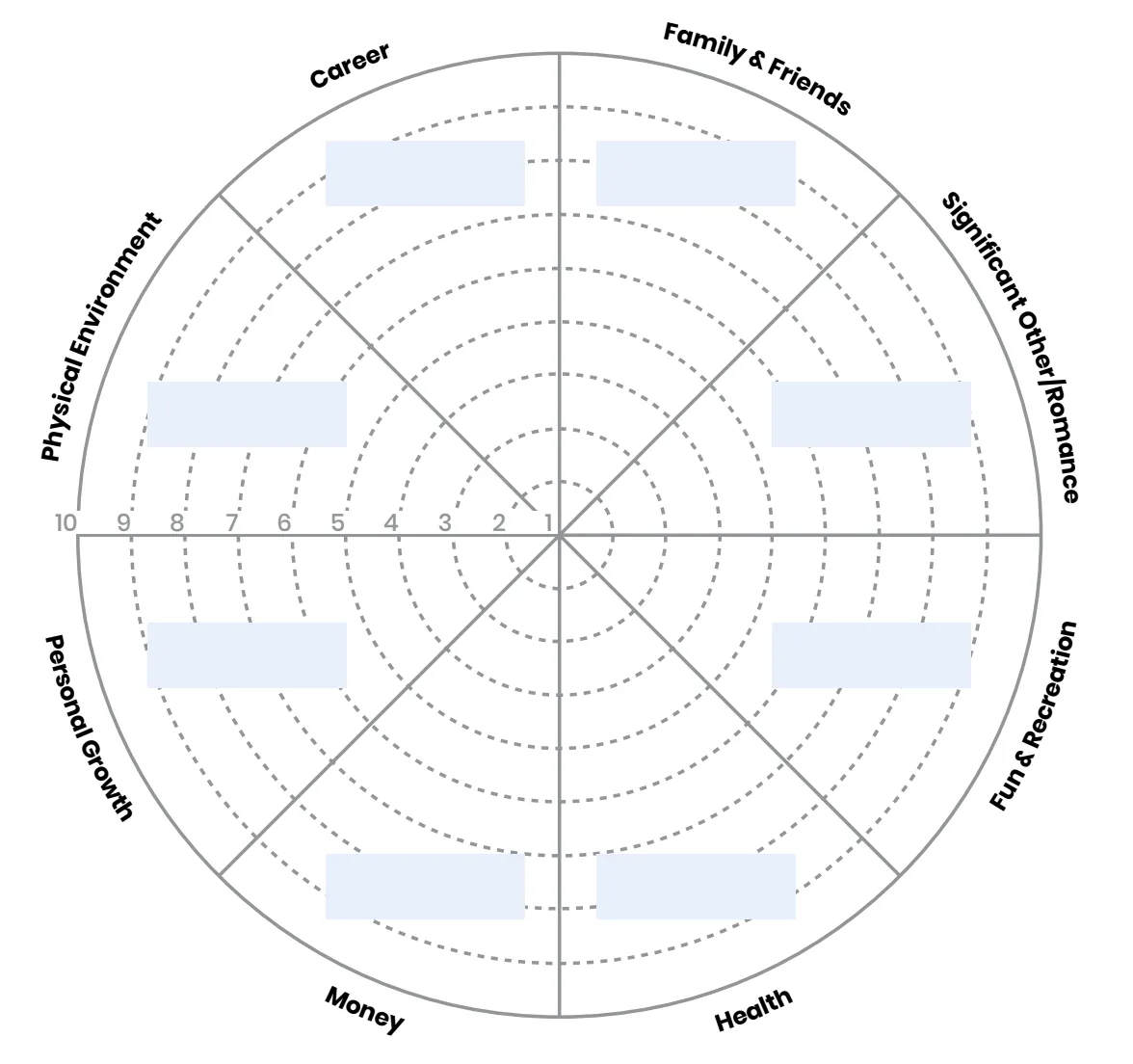
I love the Co-Active Wheel of Life as a simple and powerful way to examine where you are and where you want to grow in life. The exercise is simple:
- Take a moment to read the aspects of a fulfilling life and reflect on where you are
- Rate each category on a scale of 1-10 for how satisfied you are with that aspect of your life
- Observe what you learn by having done that
- Focus on one area where you’d like to grow
- Explore what you would like it to be, and what does your life look like at that number
Wheel of Leadership
The leadership wheel examines the competencies of great leadership with a similar thought pattern. There are many great frameworks that could be utilized as the categories. Here’s one perspective:
- Vision & Strategy – Ability to set a clear direction and long-term goals.
- Decision-Making – Making timely, informed, and effective decisions.
- Communication – Clearly articulating ideas and aligning teams.
- Emotional Intelligence – Self-awareness, empathy, and interpersonal skills.
- Execution & Accountability – Driving results and ensuring follow-through.
- Innovation & Problem-Solving – Encouraging creativity and navigating challenges.
- Team Development & Coaching – Growing and empowering others.
- Influence & Stakeholder Management – Navigating relationships and driving buy-in.
Balance Formula
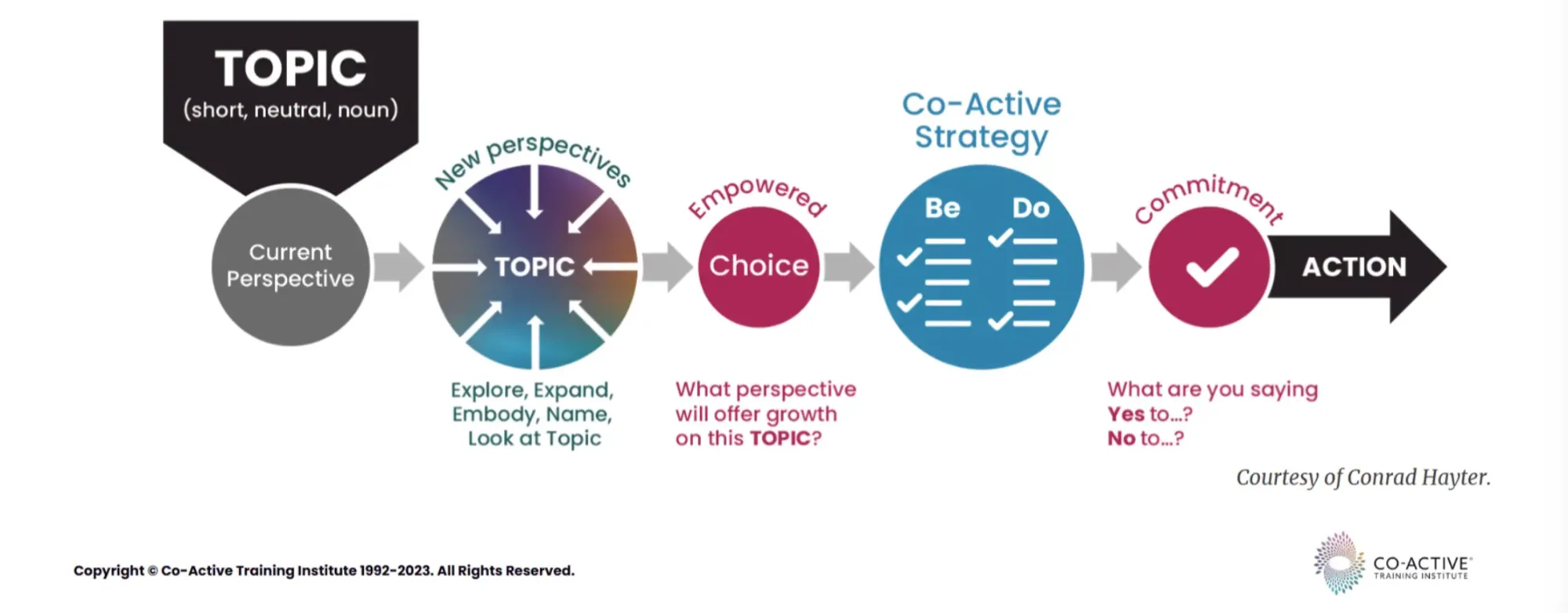
This is a great tool / process to examine a given topic from multiple perspectives. It ultimately helps us separate from a specific viewpoint where we feel stuck and move into empowered action.
-
Concisely describe a topic
-
Articulate your current perspective
💡 Examples of good topic / perspective statements:
- I want to delegate to an employee but she’s not ready to take it on
- I want to increase my sales but don’t know how to approach it
-
Embody a few new perspectives and look at the same topic
💡 Examples different perspectives and how they alter the topics
- From a feeling of red energy, I see increasing sales as an exciting challenge
- From the perspective of salad, I see delegating to an employee as a mixed bag
-
Choose the perspective (or combo) that feels most empowering
💡 Examples:
- From a perspective of ocean, I feel energized and okay with some tumult.
-
Brainstorm a bunch of ideas — include both what you are doing and who you are being
-
Ask what of those you want to say yes or no to (within a timeframe)
-
Commit to the most energizing of those
Most of us naturally become attached to “our perspective”, and this is an empowering and super fun exercise that helps us realize we are capable of holding multiple perspectives and choosing one from which to take action.
Strengths / Weaknesses / Unknowns
I first learned this tool through John Carter in relation to a hiring decision. It’s a great example of slowing down to move fast.
I had interviewed this candidate twice, and she had already met 4 people on the team. (That’s over 6 hours of our collective time, plus hers!) And still I was not at a clear yes or no. I asked John for help.
John, looking only at her resume, (that’s 15 minutes!) summarized her candidacy as follows:
Strengths
- Intellectual horsepower
- Career progression
- Energy / enthusiasm
Weaknesses
- Overly verbose
- Tasks over outcomes
- Domain experience
Unknowns
- Clarity to ambiguity
- Emotional intelligence
- Work style fit
I was astounded. For all the time I had spent and asked of my team and the candidate, this perfectly summarized my view. Not only that, my answer became totally clear: though her strengths were mighty, the weaknesses would certainly limit her effectiveness, and (crucially) the unknowns were not aspects that I could resolve in an interview process. Was the gamble worth it? No.
I passed, and applied this lens at the resume stage for my future hires. It provided great focus for the team: by the time I asked them to meet a candidate, I was already comfortable accepting the weaknesses to gain the strengths and they focused their attention on resolving the unknowns.
This illustrated the power of a simple tool to help surface intuitions, clarify thinking, and move faster.